Spouse Visas for U.S. Citizens
A foreign spouse of a U.S. citizen may generally qualify for an IR-1 or CR-1 immigrant visa after the U.S. citizen files Form I-130.
CR-1 Visa
The CR-1 category applies when the marriage is less than two years old on the date the foreign spouse obtains permanent residence.
The spouse receives conditional permanent residence for two years and must normally file Form I-751 during the 90-day period before the conditional Green Card expires.
IR-1 Visa
The IR-1 category generally applies when the marriage is at least two years old when permanent residence is granted.
The spouse normally receives permanent resident status without the two-year marriage condition.
Spouses of Green Card Holders
A lawful permanent resident may sponsor a spouse and eligible unmarried children under the F2A family-preference category.
Unlike immediate-relative visas for spouses of U.S. citizens, F2A visas are numerically limited. The applicant may therefore need to wait until a visa is available according to the Department of State Visa Bulletin.
K-3 Spouse Visa
The K-3 is a temporary non-immigrant category for the foreign spouse of a U.S. citizen. It was created to allow the spouse to enter the United States while the immigrant petition is pending.
The U.S. citizen must first file Form I-130 and then Form I-129F. After entering the United States, the spouse must separately complete the permanent-residence process. In practice, many cases proceed directly through the IR-1 or CR-1 immigrant visa route.
Other Family Immigration Pathways
Depending on the sponsor’s status and family relationship, family immigration may also include:
✓ Parent and child immigrant visas
✓ Family-preference categories
✓ K-1 fiancé or fiancée visas
✓ K-2 visas for eligible children of K-1 applicants
✓ K-4 visas for eligible children of K-3 applicants
✓ Certain adopted-child categories
✓ Widow or widower pathways
Immediate-relative categories are not subject to annual numerical limits, while family-preference categories are limited and may involve waiting periods.
01
Common Supporting Documents
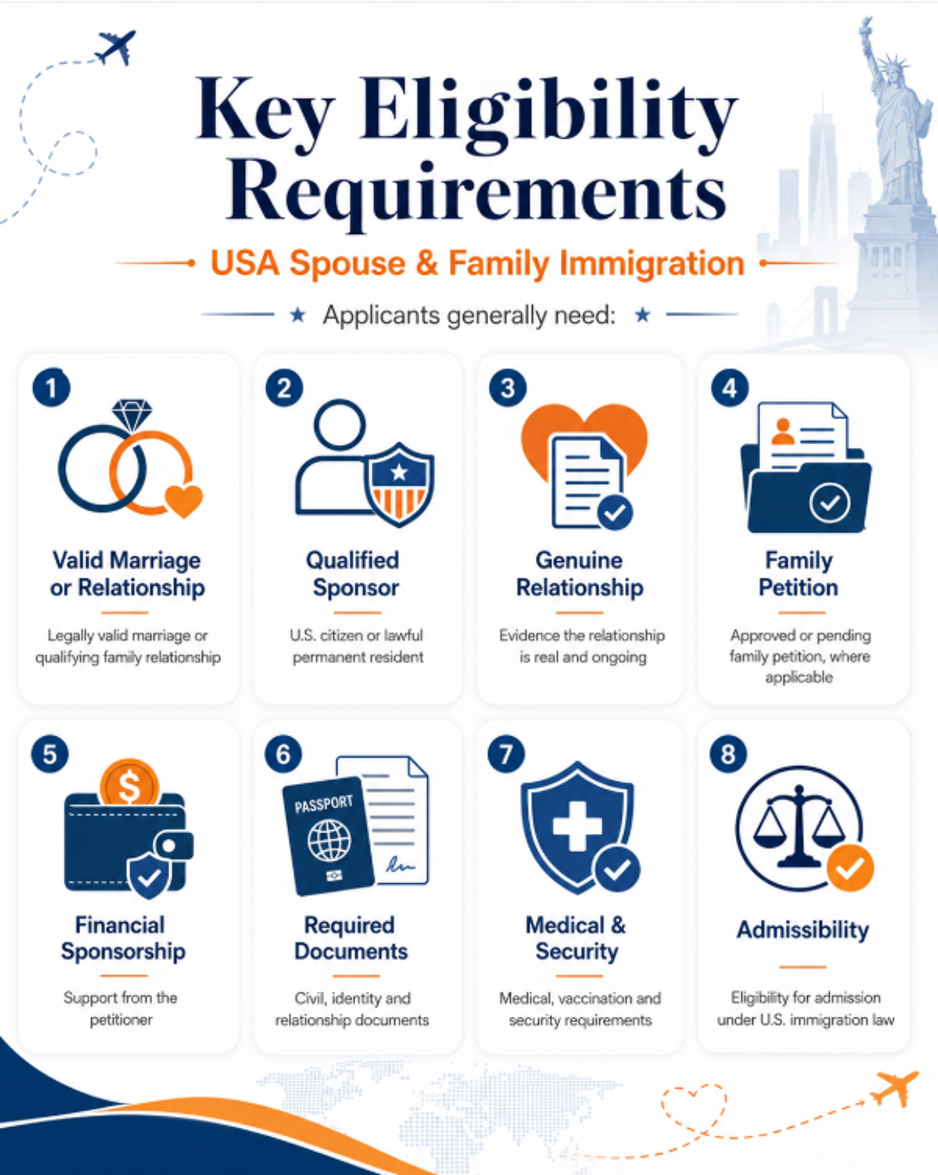
Applicants may need:
✓ Valid passports
✓ Marriage certificate
✓ Evidence of a genuine marital relationship
✓ Photographs and communication records
✓ Police certificates
✓ Medical examination and vaccination records
✓ Certified translations, where required
02
USA Spouse Visa Application Process
Confirm the Correct Family Category
↓
File Form I-130
↓
Receive the USCIS Decision
↓
Complete National Visa Center Processing
↓
Submit Form DS-260 and Civil Documents
↓
Submit the Affidavit of Support
↓
Complete the Medical Examination
↓
Attend the Consular Interview
↓
Receive the Visa Decision
↓
Travel to the United States as a Permanent Resident
After USCIS approves the I-130 petition, an overseas immigrant-visa case is generally transferred to the National Visa Center for fees, financial sponsorship, civil documents and the DS-260 application before the embassy interview.
03
Benefits of a Spouse Immigrant Visa
Permanent Residence
An approved IR-1, CR-1 or F2A immigrant visa allows the spouse to enter the United States as a lawful permanent resident.
Work Authorisation
A permanent resident can generally work in the United States without separately applying for a temporary work visa.
Family Reunification
The visa allows married couples to live together permanently in the United States.
Education and Healthcare Access
Permanent residents may study and access services subject to the same institutional, state and insurance rules that apply to other residents.
Travel Rights
Green Card holders may travel internationally, subject to maintaining U.S. residence and complying with re-entry requirements.
Potential Pathway to Citizenship
Certain permanent residents married to and living with a U.S. citizen may be eligible to apply for naturalisation after three years, provided all residence, marital-union, physical-presence and other requirements are met. Citizenship is not automatic.
Non-Immigrant Dependant Visas
Separate dependant visas may be available for spouses and children accompanying temporary visa holders. Examples include:
✓ H-4 for eligible dependants of H-1B holders
✓ F-2 for dependants of F-1 students
✓ J-2 for dependants of J-1 exchange visitors
✓ L-2 for dependants of L-1 workers
✓ O-3 for dependants of O-1 or O-2 visa holders
These are temporary visas tied to the principal applicant’s status and should not be confused with IR-1, CR-1 or F2A immigrant spouse visas. Work rights vary significantly by category.
Begin your USA spouse or family immigration journey with Open Path Immigration and receive structured guidance at every stage.
Approval, visa availability and admission are determined by USCIS, the Department of State and U.S. border authorities. Family-based rules, processing times and Visa Bulletin dates may change.